반야심경 다른 언어 버전은 아래 블로그에 있습니다.
산스크리트어 원문: https://classzangi.tistory.com/293
한국어 버전: https://classzangi.tistory.com/295
반야심경 영어 텍스트 파일입니다.
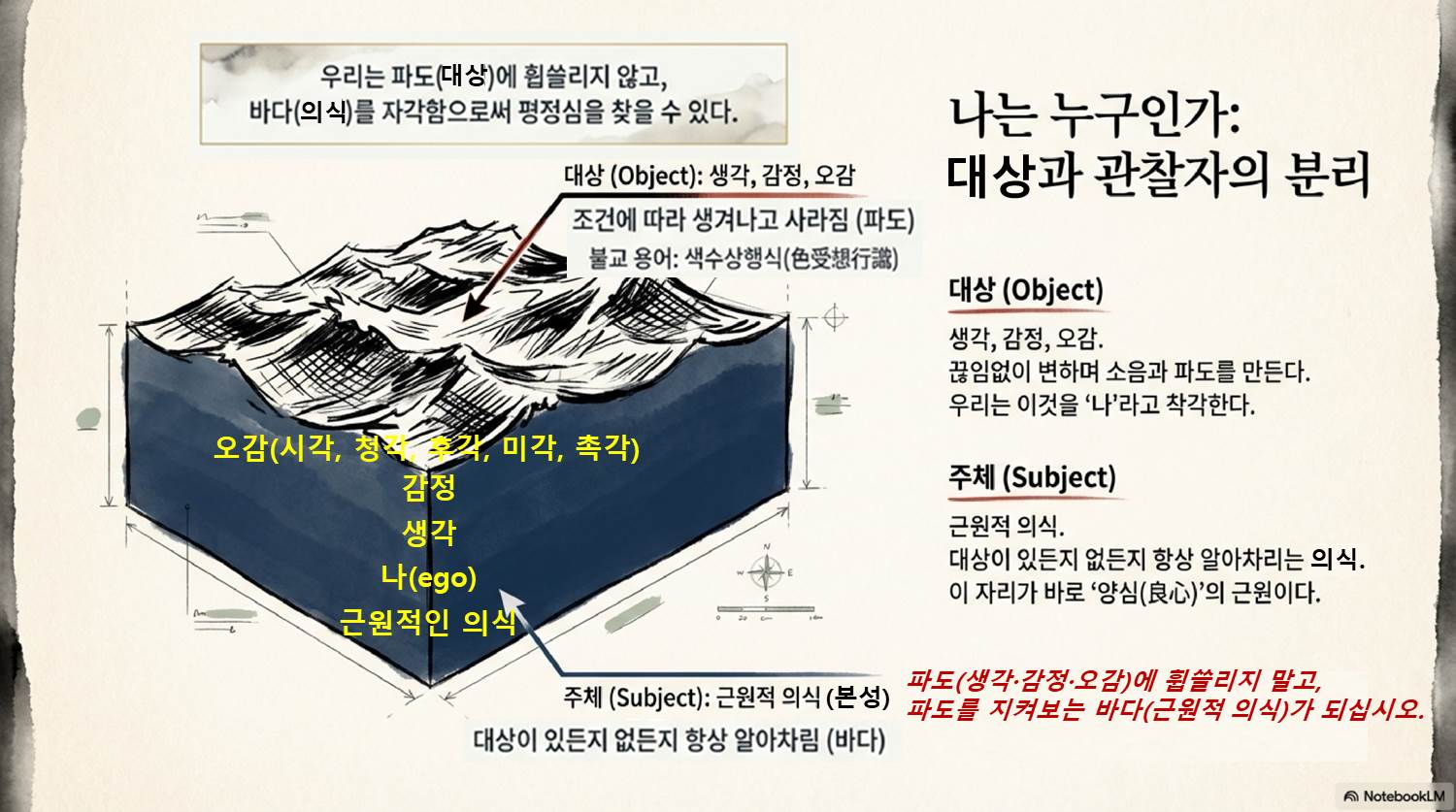
반야심경 설명 그림 입니다.
반야심경 영어 텍스트 입니다.
The Heart of Wisdom Sutra
(Prajnaparamita Hrdaya Sutra)
Translated from Sanskrit with philosophical commentary
Core perspective:
Within "the awareness that is awake even without any object,"
when conditions for an object to appear are not present,
only the principles of that object exist --
and so awareness appears empty, as if nothing is there.
But when conditions for an object to arise are met,
the corresponding principle becomes activated.
That activated principle manifests in awareness as a law,
and following that law, the object appears within awareness --
becoming "awareness that is awake with an object present."
When the conditions dissolve, the law recedes back into principle,
and the object disappears from awareness --
returning to "the awareness that is awake even without any object."
In this way, objects do not arise and dissolve independently;
they arise and dissolve in dependence upon awareness.
The word emptiness (sunyata) emphasizes
"the awareness that is awake even without any object,"
yet in truth it is "the awareness that is always awake --
whether objects are present or not."
In summary: according to conditions, through emptiness,
objects arise -- and dissolve.
================================================================
Homage to the Omniscient One.
----------------------------------------------------------------
I. THE INSIGHT OF THE BODHISATTVA
----------------------------------------------------------------
The noble Avalokiteshvara Bodhisattva (Abarokitesyubara Bodisat-ba),
while practicing the profound Perfection of Wisdom,
looked upon the five aggregates
and saw that they are empty of inherent existence.
[Commentary: Emptiness is "the awareness that is always awake --
whether objects (thoughts, feelings, sensory experiences) are present or not."
Just as a wave is not a thing separate from the ocean,
but a phenomenon arising from the ocean's own movement,
so too the five aggregates -- form, sensation, perception,
mental formations, and consciousness --
are not independent phenomena, but phenomena arising through emptiness.]
----------------------------------------------------------------
II. FORM AND EMPTINESS
----------------------------------------------------------------
Here, Shariputra:
Form is emptiness. Emptiness is form.
Emptiness is not other than form. Form is not other than emptiness.
Whatever is form, that is emptiness.
Whatever is emptiness, that is form.
The same holds for sensation, perception,
mental formations, and consciousness.
[Commentary: When conditions for an object
(thought, feeling, or sensory experience) to appear are met,
the object arises through emptiness.
When conditions for it to dissolve arise,
the object dissolves and returns to emptiness.
The object is, in this way, an activity of emptiness itself.]
----------------------------------------------------------------
III. THE NATURE OF ALL PHENOMENA
----------------------------------------------------------------
Here, Shariputra:
All phenomena are marked by emptiness.
They do not arise. They do not cease.
They are not defiled. They are not pure.
They do not increase. They do not decrease.
[Commentary: Emptiness -- "the awareness that is always awake,
whether objects (thoughts, feelings, sensory experiences) are present or not" --
is the ground in which all objects arise and dissolve.
Within it there is no discrimination, no liking or disliking.
It contains all principles by which every object arises and passes away,
yet is itself untouched by any of them.]
----------------------------------------------------------------
IV. THE GREAT NEGATIONS
----------------------------------------------------------------
Therefore, Shariputra, in emptiness:
There is no form, no sensation, no perception,
no mental formations, no consciousness.
No eye, no ear, no nose, no tongue, no body, no mind.
No visible form, no sound, no smell, no taste,
no touch, no object of mind.
No eye-element, up to and including
no mind-consciousness-element.
No ignorance, and no ending of ignorance,
up to and including no aging-and-death,
and no ending of aging-and-death.
No suffering, no origin of suffering,
no cessation of suffering, no path.
No wisdom. No attainment.
[Commentary: Emptiness does not allow objects to appear in awareness
when conditions for them are absent --
yet within it, all principles by which every object can arise
are fully present and complete.]
----------------------------------------------------------------
V. THE FREEDOM OF THE BODHISATTVAS
----------------------------------------------------------------
Therefore, because there is no attainment,
Bodhisattvas abide relying on the Perfection of Wisdom.
With no obscuration of mind,
they have no fear.
Transcending all error,
they reach the end: Nirvana.
[Commentary: Knowing that objects (thoughts, feelings, sensory experiences)
are simply activities of emptiness --
"the awareness that is always awake, whether objects are present or not" --
and no longer discriminating between liking and disliking objects,
one has no fear toward any object.]
----------------------------------------------------------------
VI. THE BUDDHAS OF ALL TIMES
----------------------------------------------------------------
All Buddhas of the three times --
past, present, and future --
relying on the Perfection of Wisdom,
have awakened to unsurpassed, complete, perfect enlightenment.
----------------------------------------------------------------
VII. THE GREAT MANTRA
----------------------------------------------------------------
Therefore, know that the Perfection of Wisdom
is the great mantra,
the mantra of great insight,
the unsurpassed mantra,
the unequaled mantra,
the allayer of all suffering.
It is true, because it is not false.
The mantra of the Perfection of Wisdom is proclaimed:
Gate gate paragate parasamgate bodhi svaha.
Gone, gone, gone beyond,
gone completely beyond -- Awakening! So be it.
[Commentary: To know and feel "the awareness that is always awake --
whether objects are present or not,"
and to understand and feel that objects arise and dissolve
within awareness according to conditions --
this is enlightenment. This is what it means to go beyond.]
================================================================
Note: This rendering is based on the Sanskrit source text.
The terms "form, sensation, perception, mental formations, consciousness"
are rendered in the commentaries as "objects (thoughts, feelings, sensory experiences)"
to reflect their meaning in contemporary language.
The philosophical view reflected in the commentaries:
Objects (thoughts, feelings, sensory experiences) do not exist independently
apart from awareness; they arise and dissolve within awareness,
and are therefore dependent upon awareness for their existence --
just as when wind (condition) blows, waves (objects) appear on the ocean (awareness),
and when the wind (condition) ceases, the waves (objects) dissolve back into the ocean (awareness).
================================================================
'철학 > 불교' 카테고리의 다른 글
| [원효대사] 대승기신론소회본(大乘起信論疏記會本) 한자 원문 (0) | 2026.05.18 |
|---|---|
| 반야심경(般若心經) 한국어 버전 (0) | 2026.05.17 |
| 반야심경(般若心經) 산스크리트어 원문 (0) | 2026.05.17 |
| 금강경(金剛經) 한국어 버전 (0) | 2026.05.16 |
| 금강경(金剛經) 영어 버전 (0) | 2026.05.16 |